Japan’s Tax-Free Shopping Changed in November 2026: The New Refund System Explained
If you shop in Japan on or after November 1, 2026, “tax-free” works differently. You no longer save the consumption tax at the register. You pay the tax-inclusive price at the shop, and the consumption tax amount is refunded later — only after customs confirms, when you leave Japan, that the goods are going out of the country with you.
The system itself has not disappeared, and the basic savings are the same. What changed is the order of events: pay first, prove you are taking the goods out of Japan, then get the tax back. This matters most at the airport, because there is now one step you must complete before you check in your bags. Miss it, and there is no refund.
This guide is based on the official guidance from the Japan Tourism Agency, the National Tax Agency, and Japan Customs. If you are still working out what a trip costs overall, Is Japan Expensive? Real Travel Costs Explained is useful background before you plan your shopping.If you are connecting
What Changed at a Glance
The switch is decided by the date of purchase, not the date you fly home. Purchases up to October 31, 2026 followed the old system; purchases from November 1, 2026 follow the refund method.
| Old system (purchases up to Oct 31, 2026) | Refund method (purchases from Nov 1, 2026) | |
|---|---|---|
| Price at the register | Tax-exclusive price — you did not pay the tax | Tax-inclusive price — you pay the full price |
| When you benefit | At the moment of purchase | After customs confirms at departure that the goods are leaving Japan |
| Who pays you back | Nobody — nothing to pay back | The tax-free shop, or a refund agent it entrusts |
| Deadline | Goods had to be taken out of Japan | Customs confirmation within 90 days of purchase |
| General goods vs. consumables | Two separate categories | The distinction is abolished |
| Consumables cap and packaging | Capped at JPY 500,000, with special sealed packaging | Both the cap and the packaging are abolished |
| Minimum purchase | JPY 5,000 or more (excluding tax) per store per day | No change |
Two points deserve emphasis. First, because the general/consumables distinction is gone, purchases are no longer split into two categories; the JPY 5,000 minimum applies to what you buy at the same store on the same day. Second, the sealed packaging for consumables has been abolished — but that does not mean you can use the goods in Japan. Consuming them before departure costs you the refund, as explained below.
Who Can Use the Refund System
The refund system is for non-residents of Japan who are visiting temporarily:
- Visitors with foreign nationality who can confirm they have been in Japan for less than six months since entry. Most tourists enter with the status of residence “Temporary Visitor,” and your passport is used to confirm this.
- Japanese nationals living abroad who have lived outside Japan continuously for two years or more and are within six months of a temporary return. Supporting documents are required.
People who live in Japan — for example on a work or study status — are not eligible, and neither are purchases for business use or resale. Goods must also be things you can personally carry out of Japan in full; some items, such as gold and platinum bullion, are excluded altogether.
Eligibility is checked at the shop, so bring your passport when you go shopping, not just when you leave.
Step by Step: How the Refund Method Works
Step 1: Buying at the shop
Shop at a tax-free shop, and spend at least JPY 5,000 (excluding tax) at the same store on the same day. Show your passport so the shop can confirm you are eligible. You will be charged the tax-inclusive price — the same price a resident would pay.
Before you leave the register, note one thing: how your refund will be paid. The shop explains how to register your refund method at the time of purchase, and the method differs from shop to shop. Keep your receipts and any refund instructions together. If you are deciding what is actually worth bringing home, start with Best Souvenirs to Buy in Japan (That Aren’t Cheesy) before you spend.
Where a shop handles procedures through a shared procedure counter, purchases at multiple stores on the same day may be combined at that counter for the JPY 5,000 check. Arrangements vary, so confirm at the shop if you are counting on this.
Step 2: At the airport or seaport — before you check in your bags
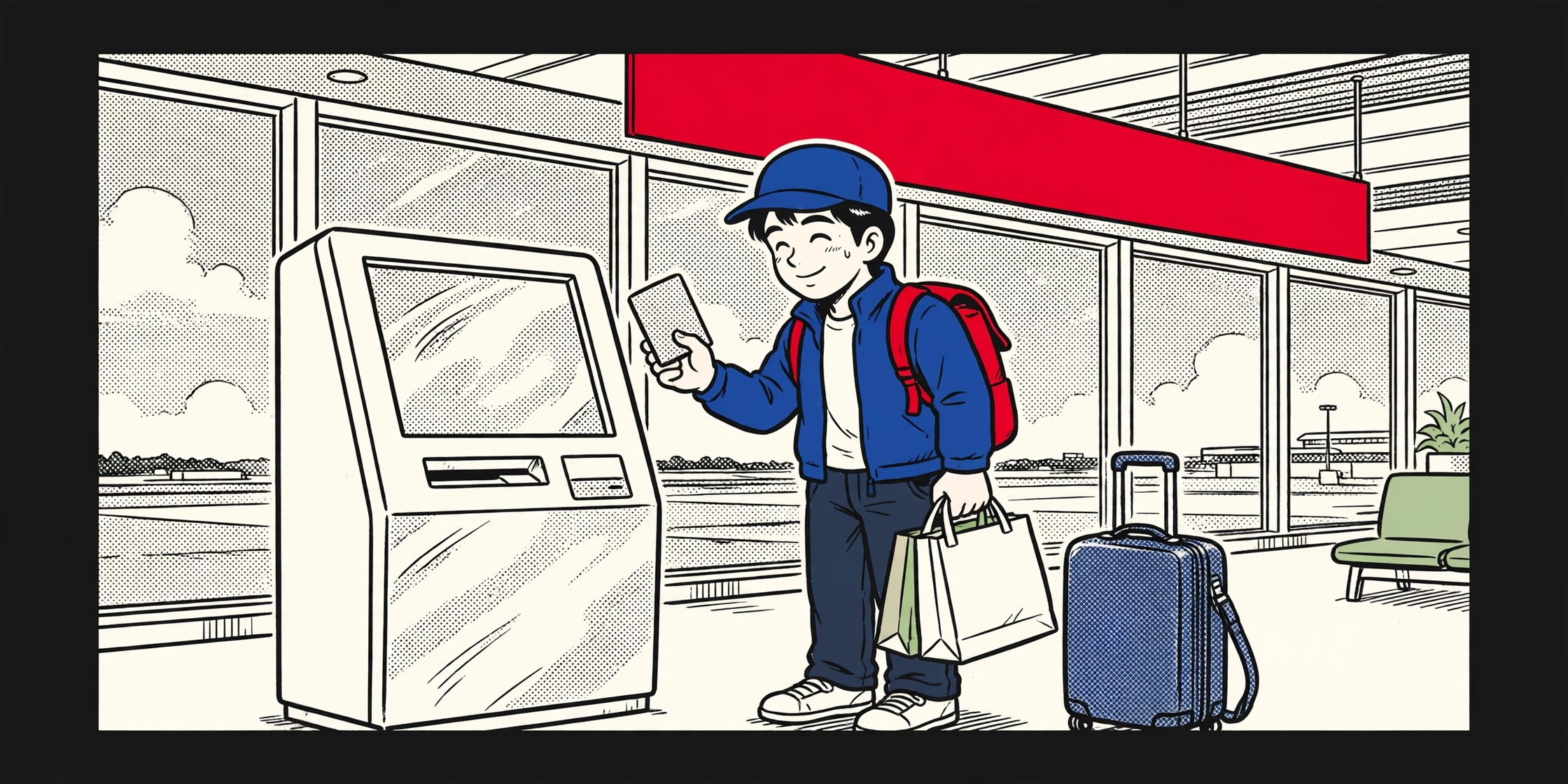
This is the step the new system adds, and the one most likely to catch people out. On departure, go to a tax-free procedure terminal (a kiosk or electronic terminal) in the international departure lobby and present your passport. The screen will show one of two results:
- Green result: no inspection is needed, and customs confirmation is complete.
- Red result: an inspection is needed, and customs officers will check your goods at the customs inspection area.
You must have all of your purchased tax-free goods with you. That is why the order matters: complete this procedure before you check in your baggage. Once a bag has been checked in, it cannot be retrieved for the tax-free procedure. Confirmation must also be finished before your boarding procedure, so arrive with time to spare.
At seven airports — Narita, Haneda, Kansai, Chubu, Fukuoka, New Chitose, and Naha — you can instead complete the procedure online via Visit Japan Web, within the departure lobby area covered by the dedicated Wi-Fi for the procedure, up to the security checkpoint. The online procedure is limited to certain statuses of residence, such as Temporary Visitor, and is not available to Japanese nationals.
If you have not set up Visit Japan Web yet, Visit Japan Web, Explained: The One QR Code You Need Before Landing walks through the registration step by step.
If you are connecting from a domestic flight to an international flight, do the procedure at your final departure airport, not the first one. And in all cases it must happen within 90 days of each purchase date.
Step 3: Receiving the refund
Customs does not hand you the money. After confirmation, the amount equivalent to the consumption tax is refunded by the tax-free shop, or by a refund agent the shop has entrusted with the procedure.
Possible methods include bank transfer, refund to a credit card, transfer through an app, and cash within the airport or seaport after confirmation. Which applies to you depends on the shop — tax law sets no single rule for how refunds must be paid — which is why registering your method at the time of purchase (Step 1) matters. For questions about a specific refund, the official advice is to contact the shop. If your refund comes back in cash, Do You Need Cash in Japan? Payment Tips for Travelers explains where cash is still useful.
One firm rule sits behind all of this: confirmed goods must be exported without delay. If they are not taken out of Japan, the consumption tax equivalent will be collected and penalties may apply.
Common Mistakes That Cost You the Refund
- Checking in your bags first. Goods inside a checked suitcase cannot be presented, and checked baggage cannot be brought back. Visit the terminal before the check-in counter.
- Missing an item from a receipt. Confirmation is handled per purchase transaction — per receipt. If even one item from a single receipt is missing, none of the goods on that receipt can be confirmed.
- Eating, drinking, or using consumables in Japan. If food, drinks, cosmetics, or other consumables are consumed before departure, they cannot be confirmed. If you have consumed part of a purchase, do not use the terminal — declare it to a customs officer at the counter.
- Leaving the procedure too late. If you run out of time and abandon an inspection partway through, you are not treated as having received confirmation.
- Doing the procedure at the wrong airport. On a domestic-to-international connection, it belongs at the final departure airport.
- Skipping the refund registration at the shop. The refund method is set up when you buy; walking away without registering makes getting the money back much harder.
- Letting 90 days pass. Confirmation must be completed within 90 days of purchase. This rarely affects short trips, but it matters for long stays.
What Did Not Change
- The minimum is unchanged: JPY 5,000 or more (excluding tax) at the same store on the same day.
- The benefit is unchanged: you can still get the consumption tax back on eligible purchases. Only the timing and the proof required have changed.
- It still applies only at tax-free shops, and only to eligible visitors taking goods out of Japan for personal use.
- Your passport still matters twice — when you buy, and again at departure.
- Other taxes are separate. Charges such as local accommodation taxes follow their own rules and are not part of this refund — see the Kyoto example in Keep Planning below.
Tax-free shopping remains one of several small ways to keep a trip affordable, alongside the choices covered in Can You Travel Japan on a Tight Budget?
FAQ
Q: I bought something on October 30, 2026, but I fly home in November. Which system applies to me?
A: The purchase date decides. Purchases up to October 31, 2026 follow the old system, in which you paid the tax-exclusive price at the register. The refund method applies to purchases from November 1, 2026, regardless of when you depart.
Q: Can I open and use things I bought tax-free while I am in Japan?
A: The sealed packaging for consumables has been abolished, but if consumables such as food, drinks, or cosmetics are consumed in Japan, they cannot receive customs confirmation — and without confirmation there is no refund. Keep consumables unused until after you leave, and keep everything together for a possible inspection.
Q: How is my refund paid, and how long does it take?
A: The tax-free shop or its refund agent pays it, generally after customs confirmation at departure makes the sale final. The method — bank transfer, credit card, app transfer, or cash at the port of departure — varies by shop, and official guidance does not promise a single timeline. Register your method at purchase and ask the shop directly if timing matters.
Final Checklist
- Confirm you are eligible: a non-resident visitor in Japan for less than six months, shopping for personal use.
- Take your passport shopping — eligibility is confirmed at the register.
- Spend at least JPY 5,000 (excluding tax) at the same store on the same day, and expect to pay the full tax-inclusive price.
- Register your refund method at purchase, and keep receipts and refund instructions together.
- Do not consume consumables before departure, and keep every item from each receipt with you.
- At departure, go to the tax-free procedure terminal before checking in your baggage, and present your passport.
- On a red result, take your goods to the customs inspection area — allow extra time.
- Connecting from a domestic flight? Do the procedure at your final departure airport.
- After confirmation, take the goods out of Japan without delay, and follow up with the shop — not customs — if your refund does not arrive.
Official Information
- Japan Tourism Agency — Tax-Free Shopping: Information for Travelers on the Refund Method (English)
- Japan Tourism Agency — FAQ for Travelers on the Refund Method
- National Tax Agency — The Shift of the Tax-Free Shopping System to the Refund Method
- Japan Customs — Customs Procedure Details: Tax Exemption (Refund) Program for Foreign Visitors
Rules and shop arrangements can change, so confirm time-sensitive details with the official sources above or with the shop before you buy.
Keep Planning
- Best Souvenirs to Buy in Japan (That Aren’t Cheesy) — Decide what is worth buying before the refund rules matter.
- Can You Travel Japan on a Tight Budget? — Put tax-free savings in context with the rest of your trip costs.
- Kyoto’s New Accommodation Tax: What Travelers Need to Know — A different, local tax that works separately from tax-free shopping.