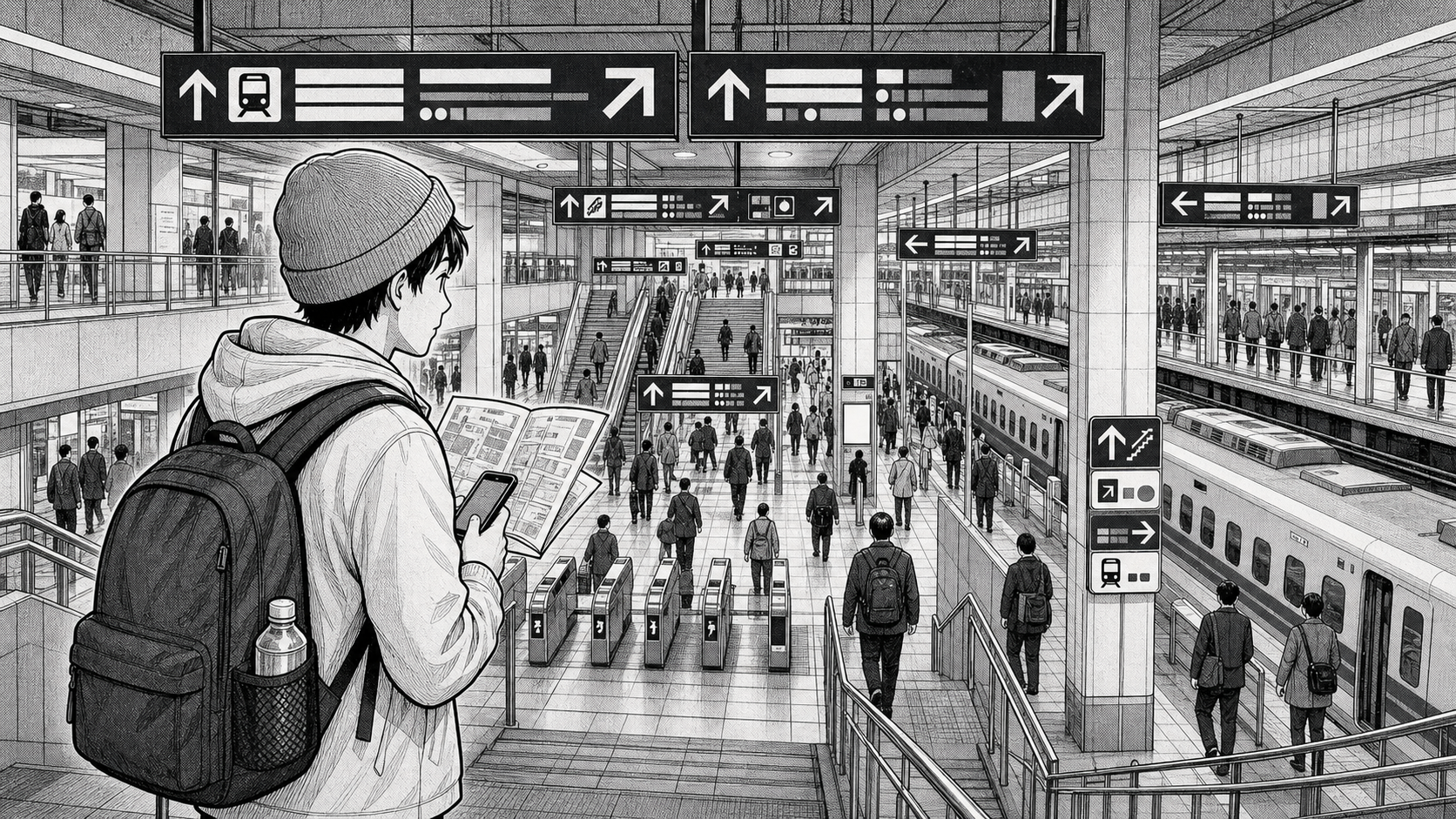
Japanese train stations have a reputation for being incredibly complex and confusing to navigate, especially for foreign visitors. This reputation is both deserved and exaggerated, depending on various factors. This article explores the reality of navigating Japanese train stations and provides insights into understanding their apparent complexity.
The Scale and Complexity of Japanese Stations
- Multiple railway operators and competing lines in major cities
- Extensive underground networks with multiple levels
- Numerous exits numbered by direction and landmarks
- Complex interchanges between different train types
Major Terminal Stations: Shinjuku, Shibuya, and Tokyo
Shinjuku Station serves as the quintessential example of Japanese railway complexity. With over 200 exits, 35 platforms, and handling more than 3.5 million passengers daily across multiple railway companies including JR East, Keio, Odakyu, and Toei, it stands as one of the world’s busiest railway stations. The station spans several city blocks with multiple levels above and below ground, requiring passengers to navigate through a labyrinth of corridors, escalators, and elevators.
Shibuya Station, famous for its iconic scramble crossing, presents its own challenges with multiple railway operators (JR East, Tokyu, Keio, Tokyo Metro, Toei) converging in one location. The recent renovation has improved navigation with clearer signage and more intuitive pathways, but the station still handles approximately 2.4 million passengers daily across its 7 platforms and numerous exits.
Tokyo Station, with its distinctive red-brick architecture, serves as the main intercity hub for Shinkansen (bullet trains) as well as multiple JR lines. While appearing more orderly than Shinjuku, it contains multiple underground levels, numerous restaurant and shopping areas, and complex transfer routes between different lines, particularly between the Marunouchi and Yaesu sides.
Regional Differences in Station Complexity
Station complexity varies significantly across Japan. Tokyo and Osaka represent the pinnacle of railway intricacy with their multiple competing operators and extensive networks. Kyoto, while a major tourist destination, has a more centralized system primarily operated by JR West and Kyoto Municipal Transportation, making navigation relatively simpler.
Regional capitals like Sapporo, Fukuoka, and Nagoya feature moderately complex stations with 2-3 major railway operators but generally more straightforward layouts than Tokyo. Smaller cities typically have single-operator stations with clear, simple designs focused on functionality rather than extensive shopping or dining facilities.
Rural stations often consist of just a single platform with minimal amenities, reflecting the lower passenger volumes and simpler transportation needs of these areas. These stations typically feature bilingual signage and are designed for maximum efficiency with minimal confusion points.
Challenges Faced by Foreign Visitors
- Language barriers in signage and announcements
- Different ticketing systems and fare structures
- Overwhelming number of platforms and transfers
- Cultural differences in queue behavior and crowd navigation
Common Tourist Mistakes and Misconceptions
Many foreign visitors fall into predictable traps when navigating Japanese stations. One common mistake is assuming all train services are operated by the same company, leading to confusion at ticket machines when a specific railway operator’s ticket is required. Another frequent error is misunderstanding the concept of “rapid” and “express” trains, which stop at fewer stations than local trains but may require additional fares.
Visitors often underestimate the importance of platform numbers, as some stations have multiple numbered sections (like platforms 1-10 for JR lines and 11-20 for private railway lines). Tourists also frequently misjudge transfer times, particularly during peak hours when corridors and staircases become crowded with commuters moving at a brisk pace.
A common misconception is that English signage is comprehensive throughout all stations. While major hubs in Tokyo and Osaka have reasonably good English signage, this diminishes significantly in regional areas. Another misunderstanding involves the Suica/Pasmo rechargeable cards; many visitors don’t realize these can be used at convenience stores and some vending machines beyond just train fare payment.
Technology Solutions and Digital Navigation Aids
Modern technology has significantly eased navigation challenges in Japanese train stations. Google Maps provides excellent real-time transit information in English, including platform numbers, transfer points, and even walking times between connecting services. The app’s “Offline Area” feature allows users to download maps for use without internet connectivity, crucial in areas with limited cell service.
Dedicated railway apps like Japan Travel by NAVITIME and Hyperdia offer detailed schedules, fare calculations, and platform information with specialized features for foreign visitors. Many stations now feature QR codes that can be scanned to access detailed maps in multiple languages, and some have developed dedicated apps with augmented reality features to help navigate complex underground networks.
Station-based technology includes multilingual digital signage showing real-time train information, automatic ticket gates with English instructions, and increasingly sophisticated customer service robots equipped with translation capabilities. Some major stations have implemented “wayfinding” systems using Bluetooth beacons to guide passengers through complex routes via their smartphones.
Strategies for Successfully Navigating Japanese Stations
- Pre-journey research and route planning
- Understanding basic railway terminology and symbols
- Utilizing station staff and information centers
- Learning to read station maps and timetables
- Smartphone apps and translation tools
Essential Vocabulary and Phrases for Station Navigation
Learning a few key Japanese terms can significantly improve your station navigation experience. “Kaidan” means stairs, “esukareeta” refers to escalators, and “lifuto” indicates elevators. When seeking directions, “Sumimasen, eki no ugawa wa doko desu ka?” (Excuse me, where is the station exit?) and “Donarai made desu ka?” (How many stops is it?) are useful phrases.
Railway-specific vocabulary includes “shinkansen” (bullet train), “ressha” (train), “ekimae” (in front of the station), “noriba” (platform), and “tsuika” (additional fare required). Understanding terms like “kaisoku” (semi-express), “kyuko” (express), and “tokkyu” (limited express) helps identify which services stop at your destination.
For purchasing tickets, useful phrases include “Kippu o kudasai” (Please give me a ticket), “Ikura desu ka?” (How much is it?), and “Kono made ikkagetsu desu” (I’m going to this station). When transferring, “Noriba o ugokashite mo ii desu ka?” (May I move to another platform?) can be helpful during crowded conditions.
Tips for Peak Hour Travel and Crowd Management
Navigating Japanese stations during rush hours (7-9 AM and 5-7 PM) requires special strategies. Allow extra time, as transfers may take longer due to crowded corridors and waiting areas. Stand on the left side of escalators in Tokyo (right side in Osaka) to let those in a hurry pass, and form orderly lines when waiting for trains, as Japanese commuters expect organized boarding.
During peak hours, prioritize using wider corridors and avoiding stopping suddenly in pedestrian traffic flow. Consider carrying a small backpack rather than a large suitcase to move more easily through crowds. If possible, travel slightly off-peak to avoid the most intense congestion, typically between 9:30-11 AM and 2-4 PM.
When boarding crowded trains, follow the Japanese practice of boarding quickly and standing away from the doors to allow passengers to exit first. Use “oshiete kudasai” (Excuse me) when passing through crowds, and maintain a calm demeanor even in extremely packed conditions, as Japanese commuters appreciate orderly behavior during high-traffic periods.
Conclusion
While Japanese train stations can indeed be complex and overwhelming, especially during peak hours, they are also remarkably efficient and well-organized. The apparent confusion often stems from unfamiliarity rather than actual design flaws. With proper preparation, understanding of basic principles, and utilization of available resources, navigating these stations becomes manageable. What initially seems daunting often becomes second nature with experience, revealing the impressive efficiency behind the apparent complexity.