Navigating Japan as a tourist can be challenging when you can’t read the local signs. This article provides essential guidance on understanding basic Japanese signs, helping you find your way, order food, and navigate public spaces with confidence.
Understanding Japanese Writing Systems
- Japanese uses three writing systems: hiragana, katakana, and kanji
- Hiragana represents native Japanese words and grammatical elements
- Katakana is used for foreign words and emphasis
- Kanji are Chinese characters that represent whole words or concepts
Hiragana Basics
Hiragana consists of 46 basic characters and is the first writing system taught to Japanese children. Each character represents a syllable, making it phonetic and relatively easy to learn. For tourists, recognizing hiragana can help identify common grammatical particles like “wa” (は), “no” (の), and “ni” (に), which appear frequently on signs. Mastering hiragana will enable you to read simple words, station names, and basic instructions. Learning hiragana first is recommended as it forms the foundation for Japanese pronunciation and reading.
Katakana Fundamentals
Katakana shares the same sounds as hiragana but has different characters and is primarily used for foreign words, loanwords, and onomatopoeia. As a tourist, you’ll encounter katakana in restaurant names for foreign cuisines, brand names, and technical terms. Katakana characters are generally more angular and straight-lined compared to the curvier hiragana. Common katakana you might see include “restoran” (レストラン) for restaurant, “kohi” (コーヒー) for coffee, and “hoteru” (ホテル) for hotel. While not essential to master the entire system, recognizing key katakana words can significantly enhance your navigation abilities.
Essential Kanji for Tourists
Kanji are logographic characters that represent meanings rather than sounds. While there are thousands of kanji, tourists only need to recognize a few dozen common ones. Essential kanji include: 駅 (eki) for station, 入口 (iriguchi) for entrance, 出口 (deguchi) for exit, 食堂 (shokudou) for cafeteria, トイレ (toire) for restroom, and 銀行 (ginkou) for bank. Many kanji have components (radicals) that give clues to their meaning. For example, the water radical (氵) often appears in characters related to water like river (川) and lake (湖). Learning to recognize these common kanji will dramatically improve your ability to navigate public spaces and understand important information.
Common Sign Categories and Vocabulary
- Transportation signs include stations, platforms, and ticket information
- Food and restaurant signs help identify menus and dining options
- Directional signs indicate locations, exits, and important landmarks
- Warning and safety signs communicate potential hazards and rules
Transportation Signs
Japan’s efficient transportation system relies heavily on clear signage. At train stations, you’ll find signs indicating platforms (プラットフォーム), ticket gates (改札口), and transfer information (乗り換え). Key vocabulary includes 電車 (densha) for train, バス (basu) for bus, 地下鉄 (chikatetsu) for subway, and 新幹線 (shinkansen) for bullet train. Fare information typically shows the price (料金) and destination (目的地). For purchasing tickets, look for machines labeled 切符売機 (kippu uriki). Many transportation signs include color coding – for instance, JR lines are often marked with their respective colors, making route identification easier even if you can’t read all the text.
Food and Dining Vocabulary
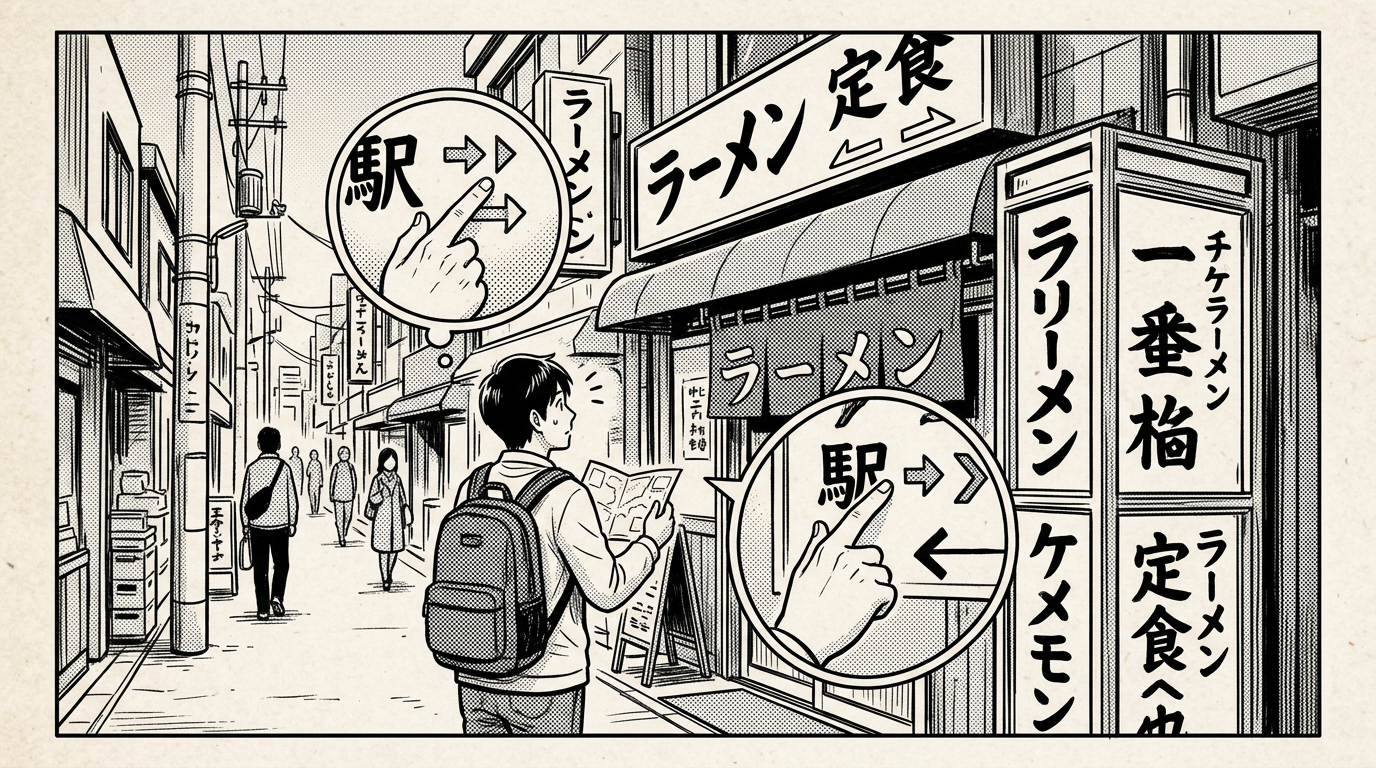
Understanding restaurant signs can help you find appropriate dining options and decipher menus. Common terms include レストラン (resutoran) for restaurant, ラーメン (raamen) for ramen, 寿司 (sushi), and 居酒屋 (izakaya) for Japanese pubs. Menus often feature pictures, but being able to read basic terms is helpful. Look for 定食 (teishoku) for set meals, ラーメン (raamen) for noodles, and グルメ (gurume) for gourmet food. Dietary information might indicate ビーガン (biigan) for vegan and ビーガリアン (biigarian) for vegetarian. Payment signs may specify クレジットカード (kurejitto kaado) for credit cards and 現金 (genkin) for cash. Many restaurants display their operating hours, with 閉店 (heiten) indicating closing time and 営業中 (eigyou-chuu) showing they’re open.
Directional Indicators
Directional signs are crucial for navigating Japan’s streets, buildings, and transportation hubs. Common directional words include 右 (migi) for right, 左 (hidari) for left, 直進 (chokusin) for go straight, and 曲がる (mawaru) for turn. Signs for important locations feature terms like 駅 (eki) for station, 病院 (byouin) for hospital, 銀行 (ginkou) for bank, and トイレ (toire) for restroom. In shopping areas, you’ll find 入口 (iriguchi) for entrance and 出口 (deguchi) for exit. Floor indicators in buildings show 階 (kai) with numbers, such as 1階 (ikkai) for first floor. Distance is typically measured in メートル (meetoru) or meters, and walking times are often indicated with 歩 (po) and a number representing minutes.
Safety and Warning Signs
Safety signs in Japan follow international standards but often include Japanese text for clarity. Emergency exits are marked with very clear signs featuring the kanji 出口 (deguchi) and sometimes the English “Emergency Exit.” Fire safety information displays 消火器 (shoukiki) for fire extinguisher and 非常口 (hiiguchi) for emergency exit. Warning signs include 注意 (chuui) for caution, 禁止 (kinshi) for prohibited actions, and 危険 (kiken) for danger. In public transportation, priority seats are marked with 優先席 (yuusenseki) or may show the universal symbol for a person with a disability. Natural disaster warnings include 津波 (tsunami) for tsunami, 地震 (jishin) for earthquake, and 避難 (hinan) for evacuation. Many safety signs use pictograms alongside text, making them understandable even if you can’t read Japanese.
Conclusion
With these basic skills for reading Japanese signs, you’ll be better equipped to navigate Japan independently. Remember that many signs include English translations in major tourist areas, but learning to recognize Japanese characters will enhance your travel experience and help you explore beyond the typical tourist destinations. Starting with essential kanji and common katakana words can provide immediate benefits, while gradually learning hiragana will open up more possibilities for understanding daily communications. Japan’s excellent public transportation system and generally tourist-friendly environment make it an ideal place to begin practicing these skills. With patience and practice, you’ll find that reading Japanese signs becomes easier, significantly enriching your travel experience in this fascinating country.