
- On-Time Performance of Japanese Domestic Airlines: A Traveler’s Guide
- Understanding Japan’s Domestic Airline Landscape
- Top Performers in Punctuality
- What Affects On-Time Performance?
- JAL vs ANA: A Competitive Landscape
- Real-Time Flight Information
- What to Do When Flights Are Delayed
- Connecting Flights Considerations
- Seasonal Variations in Punctuality
- Practical Tips for Booking
- Common Mistakes Tourists Make
- Realistic Scenarios
- Final Checklist for Domestic Air Travel in Japan
On-Time Performance of Japanese Domestic Airlines: A Traveler’s Guide
Planning a trip in Japan and worried about flight delays? Understanding the punctuality of domestic airlines can help you make smarter travel decisions. Japan’s reputation for efficiency extends to its aviation industry, but delays can still impact your itinerary, especially when connecting to international flights or important appointments. This guide breaks down the on-time performance of Japanese carriers and provides practical insights to help you navigate domestic air travel with confidence.
Understanding Japan’s Domestic Airline Landscape
Japan’s domestic aviation market features several major players alongside regional carriers that serve smaller cities. The two full-service carriers, Japan Airlines (JAL) and All Nippon Airways (ANA), dominate the market with extensive networks connecting major cities and remote regions. Alongside these, several low-cost carriers (LCCs) like Peach, Jetstar Japan, and Spring Japan offer budget-friendly options, while regional airlines such as Japan Transocean Air, Skymark, and Solaseed Air focus on specific routes, often connecting smaller islands to mainland Japan.
When planning your domestic travel, it’s helpful to understand that Japan’s airports operate efficiently, but factors like weather, technical issues, and air traffic control can still affect schedules. The country’s mountainous terrain and numerous islands make air travel essential for many destinations, with flight times often being significantly shorter than alternative ground transportation.
Top Performers in Punctuality
On-time performance is measured by how many flights arrive within 15 minutes of their scheduled time. Here’s a breakdown of Japanese airlines ranked by their on-time performance:
- Japan Transocean Air: 91.55%
- Skymark: 91.38%
- Spring Japan: 90.75%
- Star Flyer: 90.73%
- Solaseed Air: 89.12%
- Japan Airlines (JAL): 84.75%
- Jetstar Japan: 83.49%
- All Nippon Airways (ANA): 83.47%
These statistics reflect overall performance across all routes. Regional carriers like Japan Transocean Air and Skymark tend to have higher punctuality rates, partly because they operate fewer flights and often on less congested routes. The major carriers, while still performing well, manage significantly higher volumes of traffic, which can occasionally impact their on-time statistics.
What Affects On-Time Performance?
Several factors influence whether a flight arrives on time:
- Weather conditions: Japan experiences typhoons during summer months (June to October) and heavy snow in northern regions during winter, which can cause delays.
- Airport congestion: Tokyo Haneda and Osaka Itami are among the busiest airports in Japan, with tight scheduling that can lead to cascading delays.
- Crew scheduling: Airlines must adhere to strict regulations regarding crew rest times, which can sometimes affect flight schedules.
- Aircraft maintenance: Regular safety checks can occasionally cause delays, though these are typically minimized through careful planning.
- Peak travel periods: Golden Week (late April to early May), Obon (mid-August), and New Year holidays see increased traffic and potential delays.
JAL vs ANA: A Competitive Landscape
Japan’s two major carriers, JAL and ANA, compete fiercely for passengers. Interestingly, JAL consistently demonstrates slightly better on-time performance than ANA, though both remain highly reliable. This difference might be particularly relevant if you’re:
- Connecting to an international flight
- Attending time-sensitive appointments
- Traveling during peak periods
- Planning tight connections between domestic flights
JAL and ANA have different primary hubs—JAL focuses on Tokyo Haneda and Osaka Itami, while ANA emphasizes Tokyo Narita and Kansai International Airport. These hub differences can affect which carrier offers better connectivity for your specific route.
Real-Time Flight Information
Staying informed about your flight status is crucial when traveling in Japan:
- Airline apps: Both JAL and ANA offer comprehensive apps with real-time updates, mobile boarding passes, and gate information.
- Airport websites: Major airports provide flight status information on their official websites.
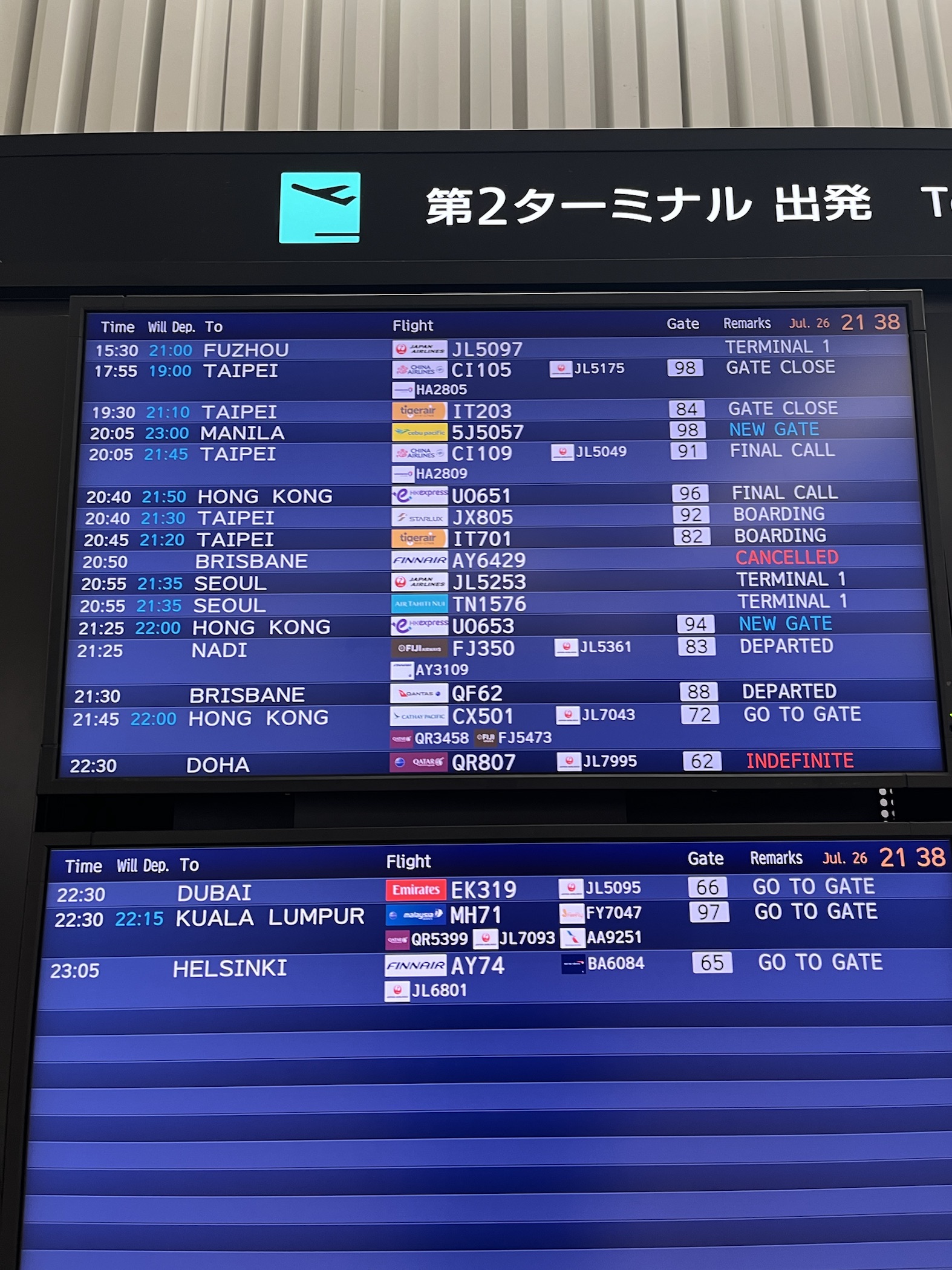
- Information displays
- Notifications: Sign up for flight status alerts via SMS or email through your airline’s website or app.
: Airport terminals have numerous screens displaying current flight statuses and gate assignments.
Checking your flight status before leaving for the airport is especially important during inclement weather or peak travel periods when delays are more likely.
What to Do When Flights Are Delayed
Despite Japan’s excellent aviation record, delays can still occur. Here’s how to handle them:
- Stay informed: Monitor your airline’s app or website for the latest updates.
- Know your options: For significant delays, airlines typically offer rebooking options on the next available flight.
- Connect with airline staff: Customer service representatives at the airport can provide assistance with rebooking or accommodation if needed.
- Keep essentials accessible: Pack medications, chargers, and important documents in your carry-on luggage in case of extended delays.
For overnight delays, airlines typically assist with accommodation arrangements, though policies may vary depending on the circumstances of the delay.
Connecting Flights Considerations
When booking connecting flights in Japan, consider these factors:
- Minimum connection times: Allow at least 60-90 minutes for domestic connections at major hubs like Tokyo Haneda or Osaka Itami.
- Same-airline connections: Booking both segments with the same airline (or partners) simplifies rebooking if delays occur.
- Terminal transfers
- Alternative airports: Consider flying into or out of alternative airports if they offer better connections or fewer delays.
: Some airports require terminal transfers, which can take 15-30 minutes. Check this when booking tight connections.
For example, if you’re connecting to an international flight from Tokyo, Haneda generally offers more convenient domestic connections than Narita, though Narita might have more direct international routes from your origin.
Seasonal Variations in Punctuality
On-time performance can vary throughout the year:
- Typhoon season (June to October): Flights to and from Okinawa, Kyushu, and southern regions may experience more delays during this period.
- Winter months: Northern airports like Sapporo and Sendai may experience delays due to snow.
- Golden Week (late April to early May): This holiday period sees increased travel volume and potential delays.
- Obon festival (mid-August): Another peak travel period when delays are more common.
If you’re traveling during these periods, consider allowing extra buffer time in your schedule or opting for morning flights, which are less likely to be affected by delays that accumulate throughout the day.
Practical Tips for Booking
When booking domestic flights in Japan, consider these strategies:
- Prioritize punctuality: If on-time performance is crucial for your trip, consider airlines with higher reliability rates, especially for time-sensitive connections.
- Morning flights: Earlier flights generally have fewer accumulated delays than later departures.
- Avoid tight connections: Build in at least 90 minutes for connections at major hubs.
- Consider regional carriers: For routes served by both major and regional airlines, the regional options often offer better punctuality.
- Direct flights: When available, direct flights eliminate connection risks entirely.
For example, if you’re traveling from Tokyo to Sapporo, both JAL and ANA offer multiple daily flights, but Japan Transocean Air might offer better punctuality, though potentially with fewer schedule options.
Common Mistakes Tourists Make
Avoid these pitfalls when planning domestic air travel in Japan:
- Underestimating connection times: International tourists often underestimate how long it takes to transfer between flights, especially at unfamiliar airports.
- Ignoring weather warnings: Japan’s weather can change rapidly, particularly during typhoon season.
- Not checking flight status: Relying solely on initial booking information without monitoring for potential changes.
- Overpacking checked luggage
- Assuming all airports are equally efficient
: For short domestic trips, consider carry-on only to avoid delays with baggage retrieval.
: Regional airports may have different procedures and fewer staff than major hubs.
Realistic Scenarios
Consider these examples to better understand how on-time performance might affect your trip:
Scenario 1: Business Traveler with Tight Schedule
A business traveler needs to attend a meeting in Fukuoka the same day they arrive at Tokyo Haneda. They have a choice between a 10:00 AM JAL flight (arriving 12:30 PM) and a 1:00 PM ANA flight (arriving 3:30 PM). Given JAL’s slightly better on-time performance and the importance of their meeting, they choose the earlier flight, allowing buffer time for potential delays.
Scenario 2: Family Vacation with Flexible Timeline
A family traveling to Okinawa for vacation has several flight options across different airlines. Since their schedule is flexible, they prioritize price and convenience over punctuality, choosing a slightly later flight with a lower-cost carrier. They build extra time into their itinerary to accommodate any potential delays without affecting their vacation plans.
Scenario 3: Solo Traveler with International Connection
A solo traveler needs to connect from Osaka to Tokyo to catch an international flight home. They have a 2:00 PM connection in Tokyo and are concerned about making their flight. They choose a morning departure from Osaka with JAL (known for better punctuality) and select a flight that arrives at least 90 minutes before their international departure, giving them ample buffer time.
Final Checklist for Domestic Air Travel in Japan
Before booking or traveling, use this quick reference to ensure a smooth experience:
- Check on-time performance statistics for your specific route and airline
- Allow extra buffer time for connections, especially at major hubs
- Download your airline’s app for real-time updates
- Sign up for flight status notifications
- Consider morning flights for better punctuality
- Check weather forecasts before departure, especially during typhoon or snow seasons
- Keep essential items in your carry-on luggage
- Know your options if your flight is delayed
- Consider regional carriers for routes where they offer good punctuality
- Build flexibility into your itinerary when possible
By understanding the on-time performance of Japanese domestic airlines and planning accordingly, you can minimize travel disruptions and make the most of your time in Japan. Whether you’re a business traveler with a tight schedule or a tourist exploring the country’s diverse regions, these insights will help you navigate Japan’s efficient aviation system with confidence.