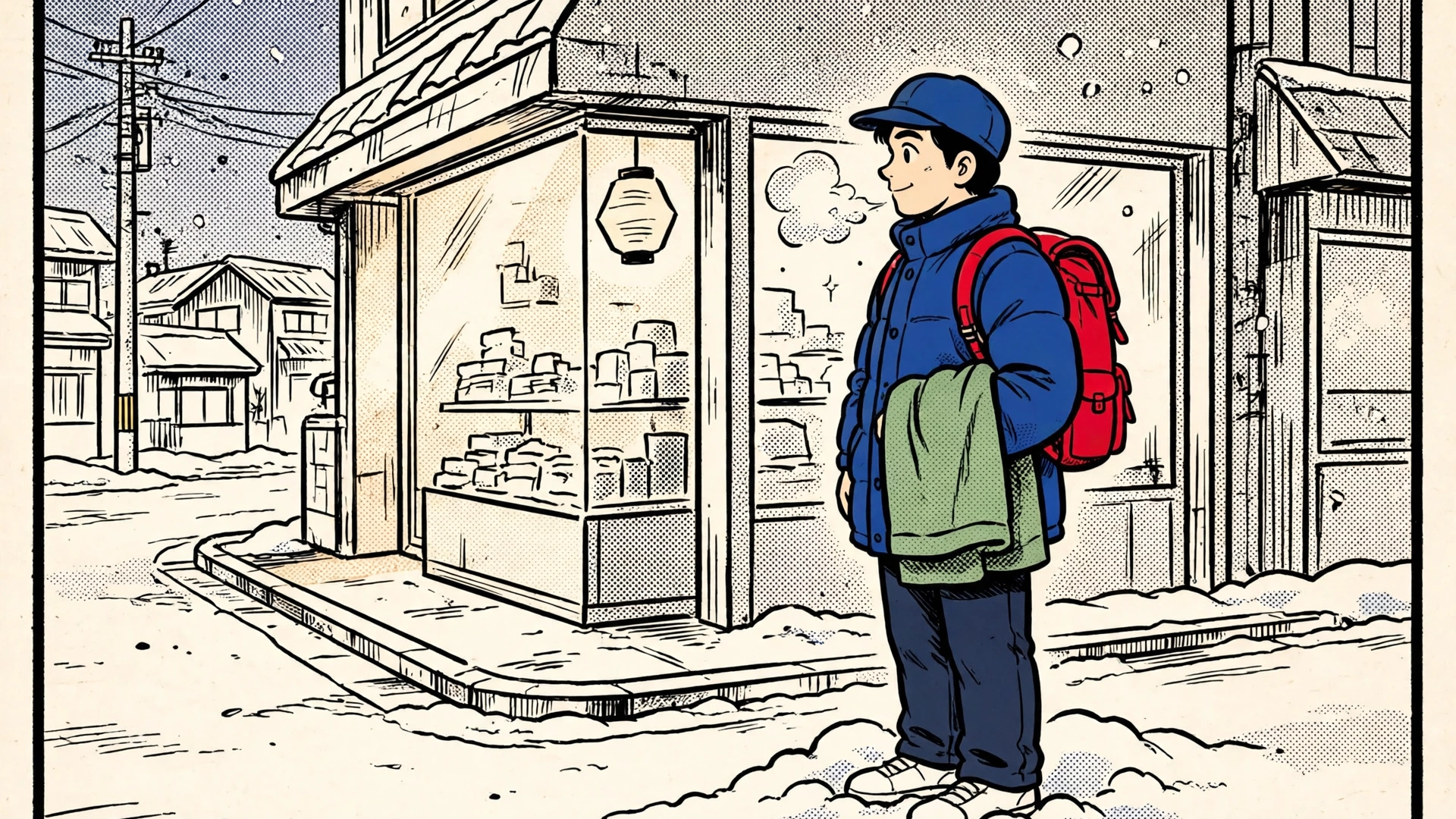
The hard part of dressing for winter in Japan is not the cold itself. It is the swing: a shrine courtyard near freezing at 8 a.m., then a department store an hour later where you are peeling off layers. Dress for the coldest street and you overheat indoors; dress for the shops and you shiver at the bus stop. The system that works is three light layers you can remove one at a time — plus the right shoes, because in snow country it is the ground, not the air, that ends trips early.
“Winter” also means different things in different cities. This guide uses the Japan Meteorological Agency’s 30-year climate averages, then builds the outfit around them. For the all-season version, see What to Pack for a Trip to Japan in Each Season — this article is the winter-only deep dive.
How Cold It Actually Gets, City by City
The table below shows average daily highs and lows for December, January, and February, plus January snowfall, from the Japan Meteorological Agency’s 1991–2020 climate normals. These are 30-year averages, not a forecast — any single week can run warmer or colder — but they are the right basis for packing.
| City | Dec high / low | Jan high / low | Feb high / low | Jan snowfall |
|---|---|---|---|---|
| Tokyo | 12.0°C / 3.8°C | 9.8°C / 1.2°C | 10.9°C / 2.1°C | 4 cm |
| Kyoto | 11.6°C / 3.5°C | 9.1°C / 1.5°C | 10.0°C / 1.6°C | 5 cm |
| Osaka | 12.3°C / 5.3°C | 9.7°C / 3.0°C | 10.5°C / 3.2°C | 0 cm |
| Kanazawa | 10.2°C / 3.5°C | 7.1°C / 1.2°C | 7.8°C / 1.0°C | 67 cm |
| Sapporo | 2.0°C / -4.0°C | -0.4°C / -6.4°C | 0.4°C / -6.2°C | 137 cm |
| Naha (Okinawa) | 21.5°C / 16.8°C | 19.8°C / 14.9°C | 20.2°C / 15.1°C | 0 cm |
Two patterns matter. First, the Pacific side — Tokyo, Kyoto, Osaka — is cold but mostly dry and sunny: Tokyo averages 192.6 hours of sunshine in January, its sunniest month, and only 4 cm of snow. The Sea of Japan side and Hokkaido are a different winter entirely. Kanazawa gets 67 cm of January snow under just 62.3 hours of sun, and Sapporo averages 137 cm in January alone, about 4.8 metres across a full year. Naha is there for contrast: the far south barely needs a winter wardrobe.
So the packing rule splits in two: a mid-weight coat and layers for Tokyo, Kyoto, and Osaka; waterproof everything for Kanazawa, the mountains, and Hokkaido, where below-freezing Sapporo days are the default, not the exception. Winter is also event season: Seasonal Events in Japan Tourists Often Miss rounds up the dates worth planning around.
The Layering System That Works Indoors and Out
Because the biggest temperature change of your day happens at a doorway, every layer should come off in seconds and fold small enough to carry:
- Base layer — thin thermals, top and bottom. Choose synthetic or merino, which moves sweat away from the skin. Avoid cotton: it holds moisture and chills you as soon as you stop walking.
- Middle layer — fleece or light down. This is your adjustable insulation, so pick something that folds small. One thick sweater is the classic mistake: unbearable on a heated train, and bulky to carry once removed.
- Outer layer — windproof, and waterproof where it snows. A mid-weight puffer or a wool coat is enough for Tokyo, Kyoto, and Osaka. For the Sea of Japan side and Hokkaido, bring a proper waterproof winter coat, ideally with a hood.
Bring a tote or a daypack for the layers you shed — carrying the middle layer hands-free is what makes the system work. A station coin locker can hold the whole coat on a full day out (fees vary).
Plan your warmest combination for after sunset, not midday. December evenings are illumination season — Christmas in Japan: Illuminations, Fried Chicken, and Cake lists the major displays — and standing still outdoors feels far colder than walking at noon. Add the hat and gloves for the evening, even if the afternoon seemed mild.
Shoes: The One Thing That Can Ruin a Winter Day
In Tokyo, Kyoto, and Osaka, ordinary walking shoes are fine on most winter days. In Kanazawa and anywhere in Hokkaido, shoes stop being a comfort item and become safety equipment. For snow country, look for three things:
- Deep-lugged soles in soft rubber, which grip packed snow instead of skating on it.
- Waterproof uppers — slush soaks through canvas sneakers within minutes, and untreated sheepskin-style boots too.
- Ankle height or higher, so snow stays out when you step off a cleared path.
Avoid smooth soles and heels entirely on snow days. Then learn to read the ground: packed snow is reasonably grippy, but black ice — a thin film of refrozen meltwater — looks exactly like wet asphalt. Expect it where meltwater refreezes overnight: at the bottom of slopes, just before crosswalks, and in front of covered entrances. Walk with short, flat steps, put your whole sole down, and keep your hands free, not in your pockets.
The Sapporo Fire Bureau counted 2,064 people taken to hospital by ambulance after falling on snowy or icy roads between November 2025 and March 2026 — a record for the city, with December the worst month and most falls on roads, including sidewalks and crosswalks.
If you did not pack for it, fix it locally. Clip-on ice grips are sold at shoe shops, sports shops, discount stores, and even convenience stores in snow regions (around ¥1,000–2,000 as of late 2026), and snow boots are easy to find around Sapporo’s station area — for a snow-country trip, buying after arrival can beat packing them. Even a Tokyo base can meet real snow: Snow around Tokyo: An Hour Trip to Snowy Cities covers day trips into snowy towns, and on those days all the rules above apply.
Indoor Heating — and Why Some Indoor Places Feel Cold
Trains, department stores, malls, restaurants, and hotels are heated, often strongly — shirtsleeves indoors in January are normal. But there is no single “indoor temperature” in Japan: it varies by building and by room, which is why precise indoor-temperature figures in travel guides should be treated with suspicion.
The one official benchmark is a guideline, not a measurement: the Ministry of the Environment’s long-running Warm Biz campaign encourages dressing warmly so heated rooms can be kept at around 20°C. Busy trains and stores often feel warmer than that in practice — one more reason layers beat a single heavy garment.
The reverse trap catches people too: not every indoor space is warm. Temple halls, older wooden buildings, traditional inns, and open station platforms can be genuinely cold, and Japanese homes are not known for strong insulation. Keep the base layer on for traditional interiors, even when the coat comes off at the door.
Kairo and the Small Things That Help
Kairo are disposable hand warmers — iron powder that heats up when it meets air. They come in three types: stick-on warmers for clothing, ones you hold in a pocket or glove, and smaller ones made for shoes. Convenience stores, drugstores, and supermarkets sell them cheaply, and each packet states how long it lasts. They are the cheapest comfort upgrade in a Japanese winter — with safety rules, set out by the Japan Kairo Industry Association:
- Never put a warmer directly on your skin. Stick-on types go on clothing, and even then, shift their position from time to time.
- Low-temperature burns are the real risk. A warmer held against one spot for hours can burn the skin, sometimes with little pain while it happens. Move the warmer and check your skin regularly.
- Never use one while sleeping. Under bedding, heat builds up and the warmer can exceed the maximum temperature printed on the packet.
- Take extra care with children, older travellers, and anyone with sensitive skin or poor circulation.
Temples, traditional restaurants, and ryokan mean taking your shoes off often, so pack extra pairs of warm socks without holes, and favour slip-on shoes on city days. It matters most at New Year: Japan in the New Year: What Closes, What Opens, and How Hatsumode Works covers hatsumode — standing outdoors in the coldest week of the year, then shoes off inside.
Finally, do not over-pack. Thermal base layers — Uniqlo’s Heattech is the famous one — gloves, scarves, and kairo are all easy to buy after you arrive, so a forgotten layer is a short shopping trip, not a ruined holiday. Wear the bulky coat on the plane, and leave the rest to Japan’s shops.
FAQ
Q: Do I need snow boots in Tokyo?
A: No, for most trips. The climate normals give Tokyo just 4 cm of snow in January, and it rarely settles — ordinary walking shoes are fine, with waterproof shoes as a wet-day upgrade. Snow boots matter in Kanazawa, in the mountains, and in Hokkaido, or on a snow day trip from the capital.
Q: Is it really that warm indoors?
A: Often, yes. Trains and stores are heated strongly enough that a heavy sweater becomes uncomfortable, though the temperature varies by place and there is no fixed standard. The official Warm Biz guideline for heated rooms is around 20°C, and busy trains and malls can feel warmer. The safe answer is the same as everywhere in this guide: wear layers you can remove.
Q: Can I buy winter clothes after I arrive?
A: Easily. Thermal layers, gloves, scarves, and kairo are sold at convenience stores, drugstores, and clothing chains across Japan, and snow regions stock ice grips and snow boots near major stations. Many visitors pack light on purpose and buy the base layer on day one.
Final Checklist
- Match your cities to the averages: Pacific-side rules for Tokyo, Kyoto, and Osaka; snow-country rules for Kanazawa, the mountains, and Hokkaido.
- Base layer: thin thermal top and bottoms in synthetic or merino — not cotton.
- Middle layer: a fleece or light down that folds small enough to carry all day.
- Outer layer: a mid-weight coat for the Pacific side; a waterproof winter coat for snow country.
- A tote or daypack for the layers you take off indoors.
- Shoes: grippy, waterproof, and ankle-high for snow regions; easy to slip on and off for temple-heavy city days.
- Extra warm socks without holes — you will take your shoes off more often than you expect.
- Kairo for early mornings and illumination evenings — on clothing, never on bare skin, never in bed.
- Leave room in the bag: thermals, gloves, and ice grips are all easy to buy in Japan.
Official Information
- Japan Meteorological Agency — Climate normals 1991–2020 (the same official tables cover every city in this article)
- Ministry of the Environment — Warm Biz (the around-20°C guideline for heated rooms; Japanese)
- Sapporo Fire Bureau — Ambulance transports from falls on snowy roads, winter 2025–26 (Japanese)
- Japan Kairo Industry Association — Using disposable warmers safely (Japanese)
Averages describe a typical winter, not your week — check the forecast for your own travel dates.
NEXT EPISODE: Keep Planning
- Japan in the New Year: What Closes, What Opens, and How Hatsumode Works — Hatsumode means shrine visits in the coldest hours of the year — what closes, what stays open, and when crowds peak.
- Christmas in Japan: Illuminations, Fried Chicken, and Cake — December’s light displays keep you standing outdoors after dark — where to see them, and why fried chicken is involved.
- Snow around Tokyo: An Hour Trip to Snowy Cities — Ready to meet actual snow? These snowy towns are about an hour from Tokyo — and the shoe rules above apply.